
AI agents are moving into everyday operations faster than most organisations can support them. Whether they help depends on what sits underneath: the platform they run on, the data they draw from and the rules that govern what they are allowed to do.
For most organisations, AI at work has so far been limited to a chatbot role. It answers questions, summarises documents and drafts emails, but it waits to be asked, and the work that follows still falls to a person eventually.
In a security control room, an operator still has to notice the alarm, pull up the footage, check the access log and write up what happened, maybe with the help of AI. While AI can help with the write-up, the security operation still runs pretty much as it did before.
The AI agent is the true gamechanger here, if used correctly.
An AI agent is a software that completes a defined task on its own, within limits set by the organisation: reviewing an alarm, checking it against past incidents, drafting the report that follows, and passing the result to a person or to the next step in a workflow.
Agents are spreading quickly because they move AI from answering questions to doing work, proactively. Software vendors are building them into the applications organisations already rely on, turning assistants that suggest into agents that carry tasks through from start to finish. In 2025, Gartner forecast that 40% of enterprise applications would include task-specific AI agents by the end of 2026, up from fewer than 5% the year before.
For anyone running large sites, the appeal is obvious. Agents can spot risks earlier, anticipate equipment faults, take on repetitive checks and give teams better information to act on. But an agent working on its own has limits. It can detect an anomaly that never reaches the right person, or make a recommendation based on data that is incomplete or out of date. The value an AI agent brings depends on the foundation beneath it, rather than how clever the model alone is.
That foundation is AI architecture: the combination of systems that lets AI run reliably, tap on accurate data, and knowing how to work with other tools and people.
It has three layers: At the base is a platform that provides the computing power, security and shared services AI needs. In the middle, there is a data layer that gathers and organises information from across the operation. Right at the top are the AI agents themselves, who are coordinated with one another, and with human operators, so that what they find turns into action.
Why AI projects stall
Most organisations did not build their operations with AI in mind. Security, building management, access control and workforce records typically run on separate systems, bought from different suppliers at different times, each chosen for its own job. Many of these systems were also installed way before AI was commonplace.
Legacy systems work well enough on their own, but what they lack is a common structure that would let their data be combined, compared and trusted.
In Deloitte’s State of AI in the Enterprise 2026, 42% of companies said their AI strategy was highly prepared, up from the year before, yet their confidence in their technical infrastructure, data management and talent slipped. Data is the recurring weak point. In a Gartner survey of data management leaders, 63% said their organisations either lacked, or were unsure whether they had, the right data management practices for AI. Gartner went on to predict that through 2026, organisations would abandon 60% of AI projects not supported by AI-ready data.
In other words, the strategy is often ahead of the systems that have to support it. A sound AI architecture closes that gap by treating the platform, the data, and the agents as one connected system, rather than three separate projects.
The three layers of an AI architecture
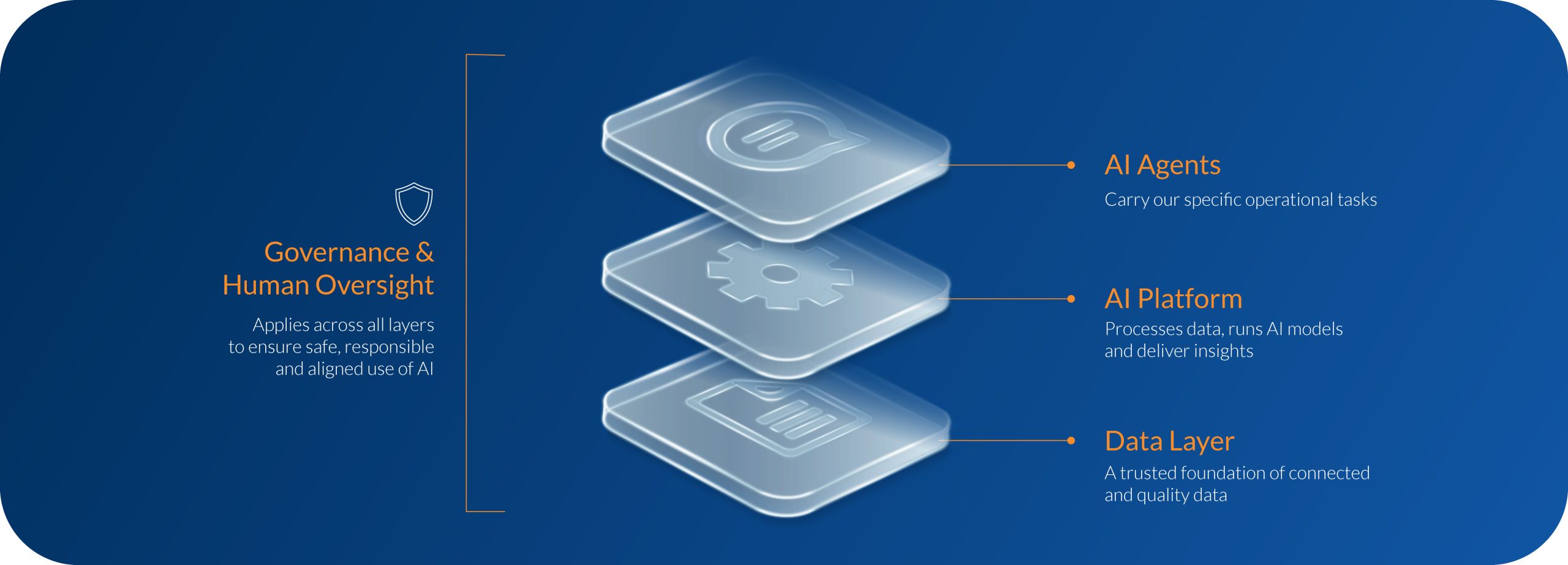
The platform: where AI runs. The platform is the foundation every AI capability depends on. It provides computing power, storage and network security, along with shared services such as access management, audit logs and workflow tools. Get this layer right, and new capabilities can be added over time without rebuilding this foundation. Get it wrong, and every new use case becomes its own project, with its own integration, its own security review and its own gaps.
At Certis, our AI foundation is called Arc, which runs across the whole organisation. Arc powers Mozart™, our operations orchestration platform, where it analyses what is happening across a site and supports the decisions that follow. It also sits beneath workflows outside Mozart™, including our back office and productivity workflows, so that AI across the business is built on a common foundation rather than a patchwork of separate tools.
Where the platform runs matters too. In security and facilities operations, some data must stay on site for security or regulatory reasons, while other functions benefit from the scale of the cloud. Mozart™ can be deployed on-premise, in the cloud or as a hybrid, so each site can strike the balance its requirements demand.
The data: turning signals into context. AI is only as good as the information it can draw from.
In a building or estate, that information comes from many places: CCTV and video analytics, IoT sensors, building management systems, access control, robots on patrol and reports filed by officers on the ground. While each source is useful on its own, they are much more powerful in describing what is actually happening when looked at in totality.
Mozart™ brings these sources together through an integration gateway that works with equipment from different manufacturers, so their data can be combined in one place. The data is then organised by context: where an event happened, which device recorded it, who was involved and what has happened at that location before. An access alarm at a restricted door means something different at 3am as compared to at 3pm, and something different again if an alert for the same door was raised twice in a week. Context is what lets AI tell the difference.
None of this works without governance at the data level. Organisations will need clear rules on who can access what, how long data is kept and how its quality is checked, because every insight produced further up depends on what is supplied here.
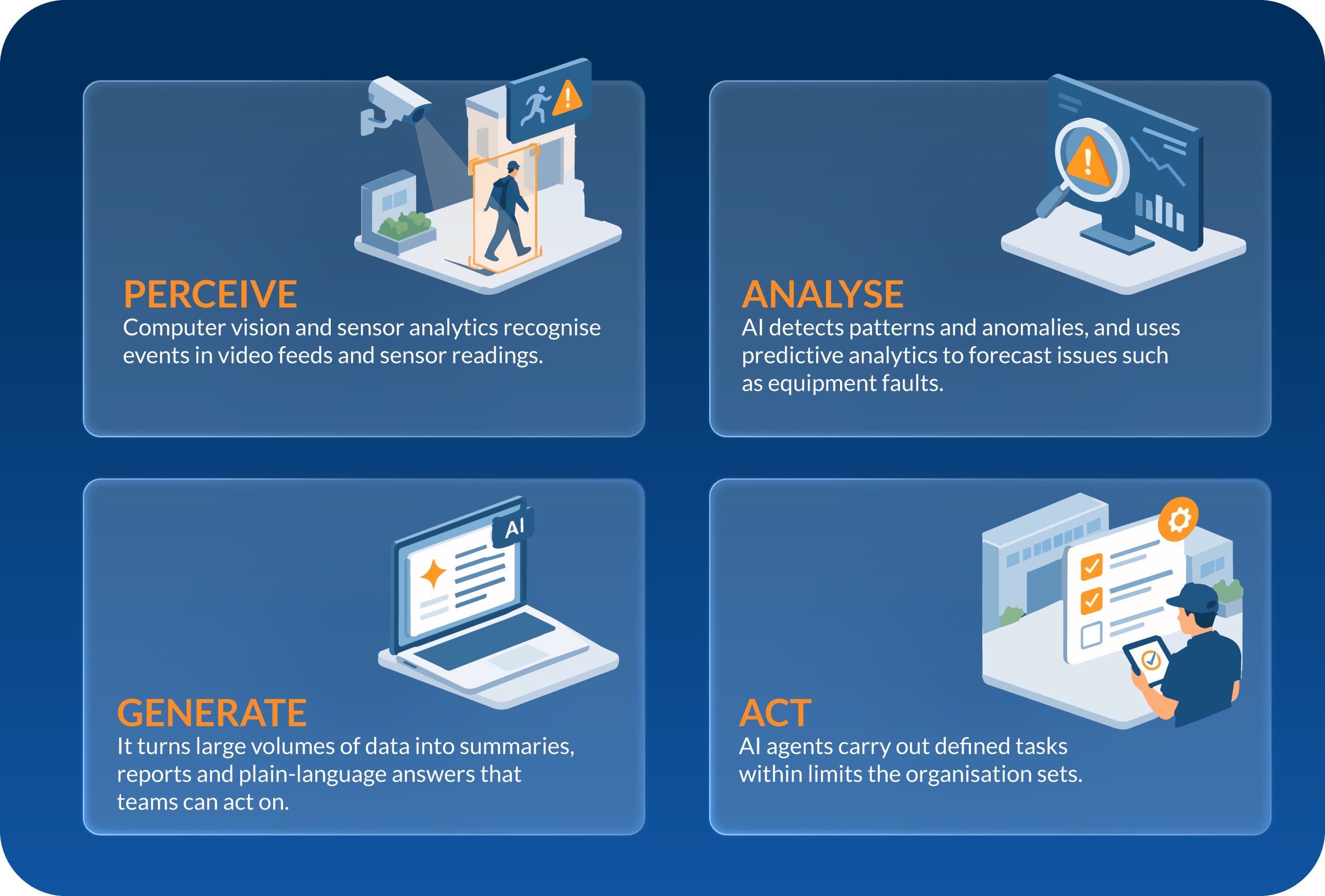
The intelligence: from perception to action. The top layer is where AI does its work. In security and facilities operations, it performs four broad functions.
Each function depends on the layers beneath it. Perception needs connected devices. Analysis needs consistent historical data. Action needs clear rules on what an agent is permitted to do, and on when a person must decide instead.
Orchestration is what holds the agents together. Individual agents handle specific tasks, such as spotting unusual activity in footage, comparing an alarm with past patterns or drafting an incident report. Arc coordinates them through automated workflows, so their outputs line up and people are brought in at the right points.
From detection to planning
Consider a commercial facility where a camera picks up unusual activity near a restricted access point. In a conventional control room, the alert lands on a screen and an operator has to pull up the footage, check the access records and decide whether to send someone. With the architecture in place, the same incident moves through four stages.
The aim is not to take people out of the decision. It is to cut the time spent gathering information and stitching together disconnected signals, so officers and operators can focus on the judgment calls only they can make.
The same architecture that handles an incident in minutes also supports planning over months. Because data from every system sits in one place, managers can see patterns that individual shifts never reveal: which areas record the most incidents, when equipment tends to need maintenance, and how manpower demand shifts by time and location.
That supports better decisions on deployment, maintenance schedules and budgets, and it is where many organisations already see returns. In Deloitte’s 2026 survey, 66% of organisations reported productivity and efficiency gains from AI, and 53% reported better insights and decision-making. Over time, the same data supports forward planning: maintenance scheduled before faults occur, and resources moved ahead of expected peaks rather than after them.
Governance built in, not bolted on
As agents take on more work, governance has to be part of the architecture. This matters more in security and facilities than in most settings, because what an agent decides can lead to real-world action involving people, assets and critical infrastructure.
Most organisations are not there yet. In Deloitte’s 2026 research, 74% of respondents expected their companies to use AI agents at least moderately by 2027, yet only 21% said they had a mature governance model for them. Deloitte describes mature governance as three things: clear limits on which decisions agents can make on their own and which need human approval, real-time monitoring that tracks agent behaviour and flags anomalies, and audit trails that record the full chain of agent actions.
Without those controls, agents can make mistakes no one notices or work at cross purposes, and the risks grow as pilots scale into full production. Deloitte also warns that retrofitting oversight later is likely to be slower and costlier than designing it in from the start.
In an AI architecture, governance runs through every layer: access rules at the platform, quality and retention rules for the data, and defined approval points within orchestration. The goal is controlled autonomy, where AI handles defined work quickly and people keep oversight of what matters.
Built for what comes next
A connected AI architecture changes how operations run in three ways.
- From reactive to predictive. Connected data and AI-driven insight help teams spot patterns and act before issues escalate.
- From routine to higher-value work. As AI takes on repetitive checks, analysis and reporting, people spend more time on decisions, intervention and service.
- From fragmented to consistent. One architecture lets information and workflows run across sites and systems, so quality no longer depends on which site, shift or system is involved.
Technology alone will not deliver these shifts. Organisations also have to redesign processes, strengthen governance and equip their people to work alongside intelligent systems. That is the idea behind One Workforce: officers, robots and AI working as one team.
As agentic AI moves on, the organisations best placed to benefit will be those with a foundation that can take on each new capability without starting over. That is why we built Arc as a single AI layer for all of Certis, rather than a collection of separate tools.
The future of intelligent operations will not be built on AI alone. It will be built on the architecture that makes AI work.
Build what’s next with Certis. Explore our AI and ops-tech capabilities →
Sources
- Gartner, Gartner Predicts 40% of Enterprise Apps Will Feature Task-Specific AI Agents by 2026, Up from Less Than 5% in 2025, 26 August 2025.
- Deloitte AI Institute, State of AI in the Enterprise: The Untapped Edge, January 2026. 3,235 business and IT leaders, 24 countries. Strategy preparedness, infrastructure, data and talent readiness, and reported benefits.
- Gartner, Lack of AI-Ready Data Puts AI Projects at Risk, 26 February 2025. The 63% data-practices finding and the 60% abandonment prediction.
- Deloitte Insights, Business and IT leaders report AI agents are scaling faster than their guardrails, Andy Bayiates, 24 April 2026. Agent adoption, governance maturity, and the three components of mature governance.