
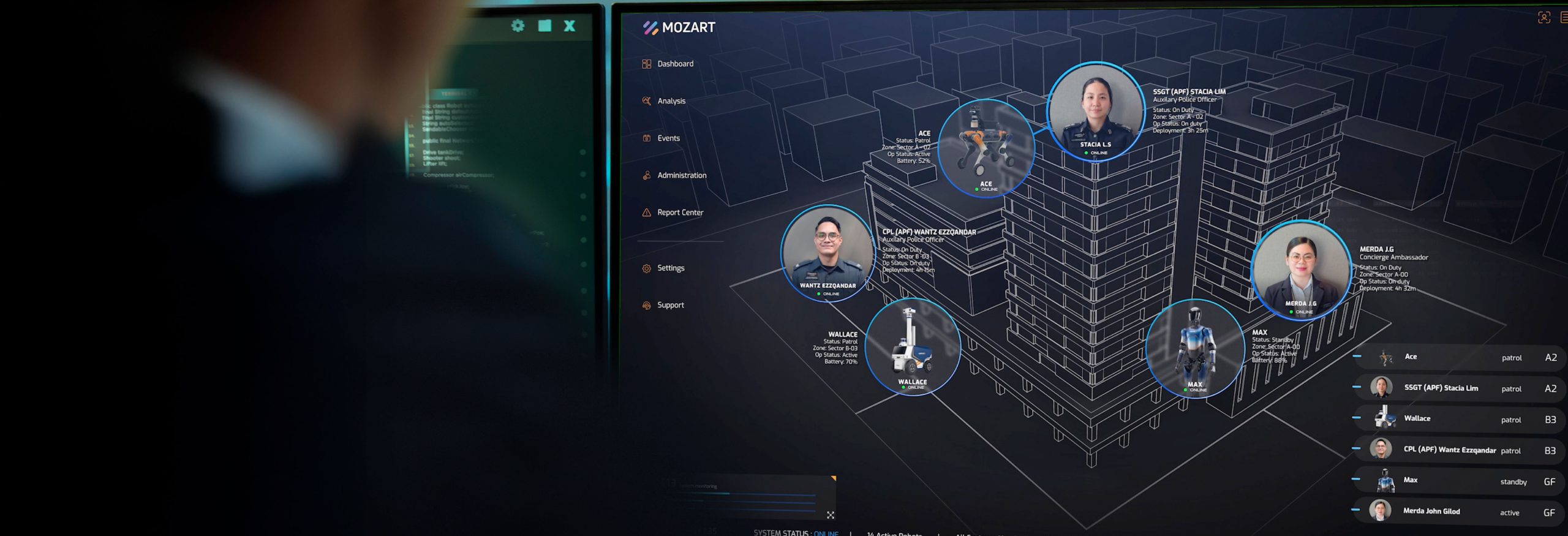
Most large sites are not short of technology. What they lack is a way to make it work together. That is the job of intelligent orchestration, and it is what we built Mozart™ to do.
Picture a large commercial building on an ordinary Tuesday. A lift breaks down on level 12, motion sensors flag unauthorised access at a loading bay, and a visitor reports a water leak near the lobby.
None of this is unusual for facilities or estate management teams. What is also usual is that each event arrives as a separate alert, goes to a separate team, and no one sees the whole picture until something goes wrong.
Most large facilities built up their technology over years: CCTV here, access control there, a building management system, a growing number of sensors. Each was bought to solve a specific problem, often from a different supplier, and each works as designed. Making sense of them together is still left to people. That is the gap intelligent orchestration closes, and it is where it goes further than the automation already built into most operations.
Automation and orchestration are not the same thing
Automation has made operations faster and more consistent, and no modern site runs without it. However, automation was conventionally built to handle single tasks, and that is where it stops. A sensor detects smoke and triggers an alarm; an access log flags an unauthorised entry. Both are useful, yet both are isolated. Each system reports its own version of events, and a person still has to spot the pattern, decide what matters and coordinate the response across teams.
Orchestration, on the other hand, connects those tasks. Instead of three alerts landing in three places, an orchestration platform brings them into a single operational view, works out what needs attention first and routes it to the people who should act.
The case for orchestration is measurable. When Singapore’s Building and Construction Authority launched its Smart FM Proof-of-Concept Grant, projects had to show more than a 20% improvement in overall productivity by integrating multiple FM services across buildings. Certis was one of the first two projects awarded the grant, in 2021.
From fragmented systems to one operational view
Walk into the control room of most large facilities and you can read the history of its technology on the wall. There is a screen for the CCTV network, another for access control, one for the building management system, and often a separate app for the facilities team. Each was added when a need arose or a contract came up for renewal, and each was chosen because it did its own job well. Few were chosen with the others in mind.
Replacing all of it with one new system is rarely realistic, given this means writing off investments that still work, retraining teams and taking on months of disruption at a site that cannot stop operating. What most operators need instead is a way to make the systems they already own work together.
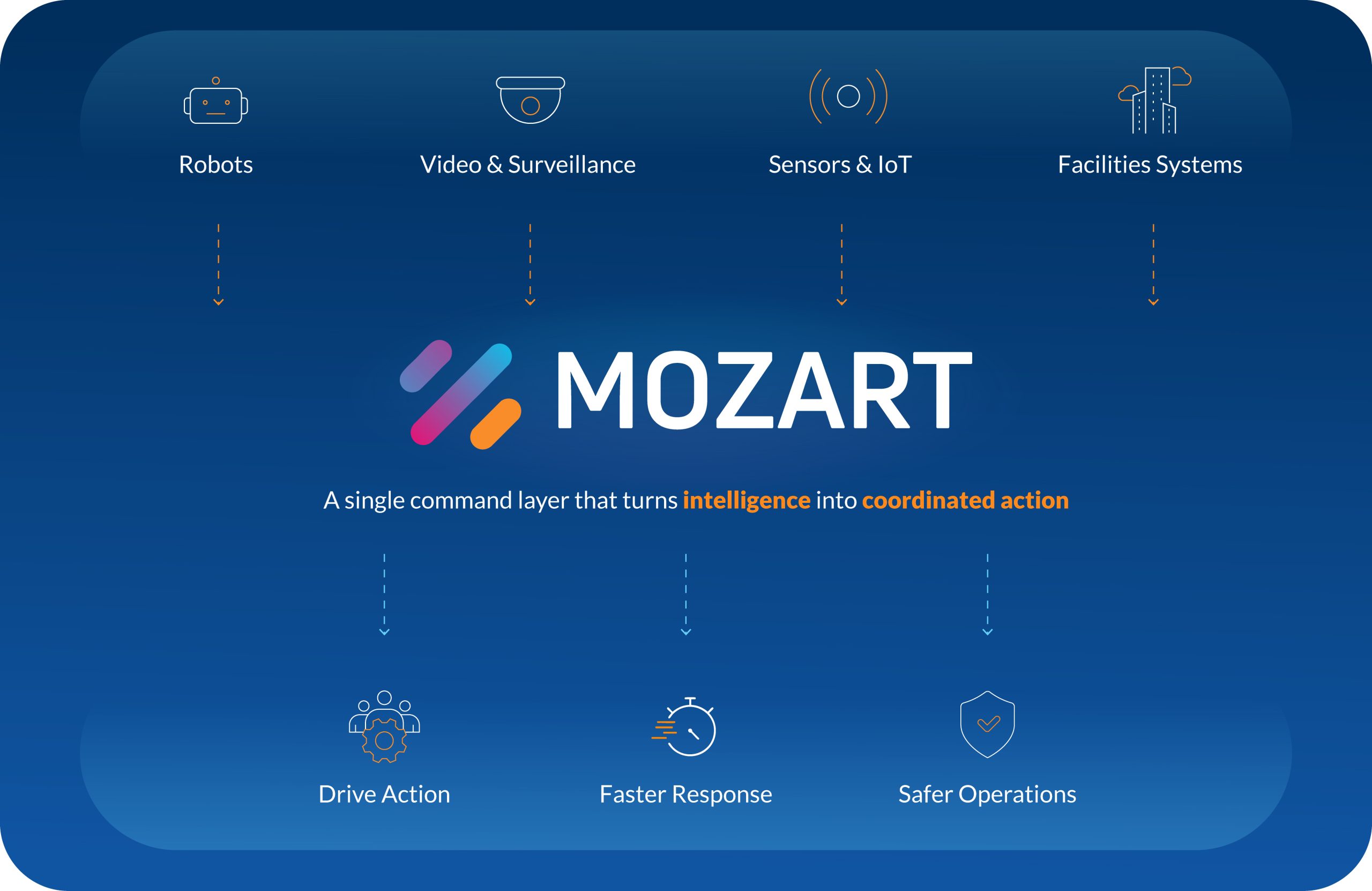
That is the thinking behind Mozart™. Rather than asking a site to standardise on one vendor, it is implemented to integrate with the systems already in place, bringing their data, alerts and workflows into a single command layer.
The operator sees one picture of the site instead of several different dashboards. When new technology arrives, whether another sensor network or a fleet of patrol robots, it joins that same picture rather than adding another screen.
How Mozart™ works
We built Mozart™, our AI-powered operations orchestration platform, from decades of running sites ourselves. Mozart™ works in four stages.
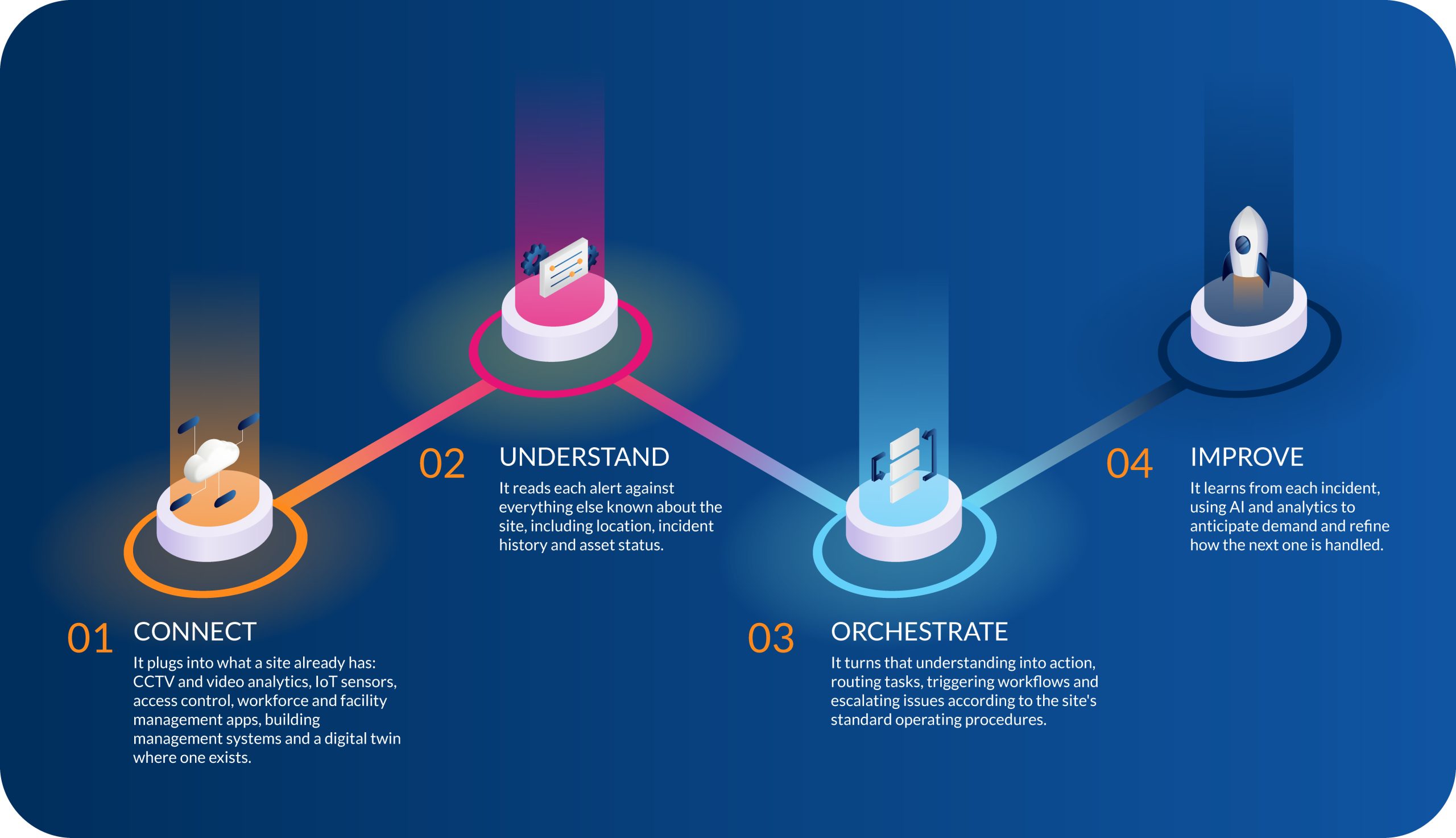
Instead of watching several screens and matching events by hand, the command centre team works from one view with context and priority already provided.
None of this requires replacing what a site already has. Most facilities added systems over time, from suppliers whose products were never designed to talk to each other. Mozart™ works across them regardless of vendor, and keeps expanding as new systems, sensors and robots are added.
Arc: AI shifting detection to decision
Connecting systems solves half the problem. The more a platform connects, the more alerts it receives, and without a way to interpret them it becomes one more dashboard to watch.
Arc is the AI layer that sits across Mozart™. For example: take the water leak we mentioned earlier. On its own, it is a sensor reading. But in Mozart™, Arc decides whether it matters by checking it against what else is happening at that location, then makes sure the right team is alerted before it becomes a bigger problem.
A person could do the same for one reading, if they happened to be watching the right screen at the right moment. Arc does it for every reading, across every site, all the time, thereby making sure someone acts on it, while the decisions that need judgement stay with people.
Mozart™ in the field: greenfield and brownfield
Orchestration has to work in two very different settings: a new site where it can be designed in from day one, and an established one where it has to fit around years of existing systems and habits.
We worked with Jewel Changi Airport right from the beginning. Mozart™ went in when the complex opened in 2019, so security, facilities management and customer service were built around one platform from the start, drawing on more than 5,000 sensors and 700 CCTV cameras across 10 floors. In 2024, Minister of State Sun Xueling pointed to this work at Jewel and at JTC’s South-West precincts as an example of how AI, data analytics and smart surveillance streamline operations and speed up incident response.
Hong Kong Science and Technology Parks Corporation (HKSTP) was the opposite: an industrial-commercial estate with established teams, long-standing ways of working and legacy infrastructure already in place. There, Mozart™ had to fit around what existed. We rolled it out in phases across security, facilities, building operations and customer services, designing workflows with HKSTP’s own teams so the platform reflected how the work is actually done, not how a process diagram says it should be. Training was tailored to each role, across day and night shifts.
Since deployment, incidents are handled faster, teams get more done with the resources they have, and service-level performance is more consistent and easier to track. The people who use the park see clearer communication and more transparency. The bigger change is in the role of the operations team itself: it has moved from managing facilities to orchestrating outcomes across the estate, on a platform ready to take on IoT and AI as the park grows.
An existing site teaches lessons a new build does not. Moving from manual workflows to a centralised model, changing long-standing habits and connecting cloud systems to legacy infrastructure all took deliberate work: a steady communication cadence, training rooted in daily tasks, and a rollout that improved with each round of feedback. Most operators are working with sites like HKSTP, not new builds, which is why the operating model matters as much as the technology.
Why technology alone is not enough
An orchestration platform cannot fix a broken process. If workflows are fragmented or responsibilities unclear, connecting the systems underneath delivers little.
That is why every Mozart™ deployment starts with the work, not the technology. Through BPRO®, our Business Process Re-engineering and Operations framework, we sit down with clients to understand how their operations actually run today: where time is lost, where handovers break down, where are the blind spots, and where manpower is tied up in tasks that add little value. Together, we redesign those processes end to end across security, facilities, building operations and customer service, then build them into Mozart™ as structured digital workflows.
The redesign is done together with the client’s teams, not for them. Co-creation workshops bring the people who do the work into the design, so the new processes reflect real operating conditions. Once the workflows are live, performance data shows where they can be tightened further, and the cycle repeats. Technology takes on the repetitive and the routine, while people focus on the decisions that need judgement.
The next frontier: One Workforce
Orchestration began as a way to connect systems. Its larger value is in connecting everything that does the work. As robots take on patrols and inspections, and AI reads the signals across a site, orchestration is what lets officers, robots and AI operate as one team rather than as separate resources. At Certis, we call this One Workforce.
That changes how operators plan. Instead of adding headcount or buying another system for every new problem, they can design operations around what people, machines and intelligence each do best, and adjust as conditions change.
The organisations best placed for what comes next will be those that turn intelligence into action fastest, whatever the size of their technology estate. Certis has run critical operations since 1958, and we built Mozart™ from that experience.
The next competitive advantage will not come from more automation. It will come from better orchestration.
Explore Mozart™ and our ops-tech solutions →
Sources
- Building and Construction Authority, Accelerating the Transformation of the FM Industry, 22 July 2021. Smart FM PoC Grant’s 20% productivity criterion; Certis as one of two awardees.
- Ministry of Home Affairs, Singapore Security Industry Awards 2024: Speech by Ms Sun Xueling, 15 November 2024. Certis’s work at Jewel Changi Airport and JTC’s South-West precincts.