
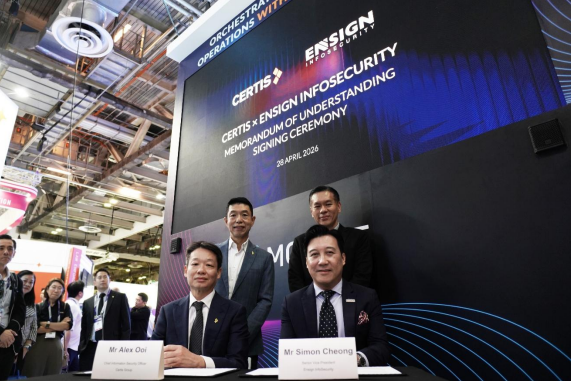
Clockwise from top left: Ng Tian Beng, President and Group CEO, Certis Group; Paul Tan, Executive Vice President of Singapore and Government Enterprises, Ensign InfoSecurity; Simon Cheong, Senior Vice President of International and Commercial Enterprises, Ensign InfoSecurity; Alex Ooi, Chief Information Security Officer, Certis Group
28 April 2026, Singapore – Certis Group, Singapore’s leading provider of integrated security and operations solutions, and Ensign InfoSecurity, Asia Pacific’s largest pure-play cybersecurity services provider, have signed a Memorandum of Understanding (MOU) at the Milipol TechX (MTX) 2026, a regional platform for security and technology innovation, to strengthen cybersecurity, safety and governance in robotic systems powered by artificial intelligence.
The partnership addresses a growing challenge as AI systems evolve from assisting humans to acting autonomously. Beyond conventional cybersecurity threats which typically result in data breaches or system outages, vulnerabilities in AI robotic systems carry an additional category of risk: manipulated sensor inputs, loss of supervisory control, or autonomous systems executing unintended physical actions with real-world consequences.
This collaboration comes as Singapore increases the deployment of autonomous systems to aid in security, logistics and transport operations, highlighting the urgent need to translate governance principles into practical, operational safeguards, particularly in real-world environments where there is little room for error.
Under the MOU, both organisations will work together to strengthen cybersecurity, safety and ethical governance in AI-driven robotics. Certis will lead the development and implementation of safety and ethics fail-safes, as well as Human-in-the-Loop interfaces within the AI robotic platform. In parallel, Ensign will oversee the development of cybersecurity requirements governing the platform’s communication interfaces, as well as the AI’s core reasoning and decision-making processes, including the design of cybersecurity controls, standards and frameworks.
Together, the partnership will embed guardrails across the full system lifecycle, from design and development to testing, deployment and eventual decommissioning, while advancing cybersecurity capabilities, cross-domain knowledge-sharing, and practical frameworks to support the secure and responsible use of autonomous systems.
“As Certis accelerates the development and deployment of our robotics and AI across our operations, we are cognisant that the power of these technologies is only as strong as the security that protects them,” Mr Alex Ooi, Chief Information Security Officer of Certis, said.
“In this new era of industrialised AI, cybersecurity is no longer a peripheral function, but a critical enabler of our future. For Certis, securing our autonomous systems means more than just protecting data; it means ensuring the operational integrity and safety of the physical environments we are trusted to guard. By embedding rigorous cyber-resilience into every tech, robot and algorithm we deploy, we are building a future where innovation and absolute trust coexist seamlessly in this partnership,’ Mr Ooi added.
Key areas of focus in the MOU include:
- Developing ethical, safety-first approaches for AI-driven robotics, supported by shared standards across data handling, model training and real-world operations
- Embedding security and risk management by design across the system lifecycle, including threat identification, risk assessment and safeguards against unauthorised access and tampering
- Implementing human-centric safety protocols and robust human-in-the-loop controls to ensure effective oversight and intervention
- Strengthening cyber-physical resilience through testing and operations, including adversarial testing of AI-driven robotic behaviours, continuous monitoring and specialised capabilities such as threat analysis, incident response and penetration testing
A joint Safety and Security Review Board will be established to oversee implementation and ensure alignment with evolving safety and ethical expectations.
“The rise of AI is raising the stakes for enterprise security. It goes beyond protecting systems to ensuring that autonomous decisions remain bounded, explainable and secure,” said Paul Tan, Executive Vice President of Government and Singapore Enterprises, Ensign InfoSecurity. “Having operationalised AI in security environments, we see firsthand how quickly autonomy can scale. The challenge is ensuring that control, governance and resilience scale with it, especially when these systems affect real-world operations and outcomes. This collaboration focuses on embedding cybersecurity into the way these systems are designed and deployed from the outset.”
The MOU signals a shift in how organisations deploying autonomous systems must think about risk, not as an IT concern to be managed downstream, but as a foundational design requirement woven into every layer of the system.